

Joni Dunlap: Globally Recognized for Research, Driven by a Vision for Innovative Learning Design and Technology
Julie McMorris | School of Education & Human Development Mar 23, 2026
A Career Shaping Learning Design at CU Denver
Joanna “Joni” Dunlap, PhD, professor of Learning Design and Technology in the School of Education & Human Development (SEHD), has shaped teaching and learning at CU Denver for more than 25 years. An award-winning educator and researcher, she has built a body of scholarship examining how instructional approaches, pedagogical strategies, and learning environments influence learning and performance.
Dunlap earned her PhD in Educational Leadership and Innovation from CU Denver and joined the SEHD faculty in 2000. Her research explores how learning occurs across a range of contexts, including online, classroom-based, field-based, and workplace settings. Dunlap’s research turns learning design into a real advantage for students—helping them stay focused, motivated, and ready to succeed. And in a world where online learning is part of everyday life, her work shows how thoughtful learning design can transform digital education into an experience that feels intuitive, empowering, and built for everyone.
Dunlap’s recognition in the prestigious Stanford–Elsevier global database of the top 2% of cited scientists underscores the sustained influence of her scholarship in the field of learning design and technology. The study, developed by Stanford researcher John P. A. Ioannidis and hosted through Elsevier’s open data repository, analyzes standardized citation indicators across 22 scientific fields and 174 subfields, drawing on Scopus data to evaluate career‑long and single‑year impact. With more than 7,900 citations and more than 100 publications to her name, Dunlap’s body of work reflects both depth and longevity, aligning with the rigorous criteria used to identify the world’s most influential scholars. Readers can explore the original Stanford–Elsevier dataset here: https://elsevier.digitalcommonsdata.com/datasets/btchxktzyw/8.
Dunlap credits collaboration for the impact of her work. “It is about doing the work,” she said. “Anything that resonated was something done in collaboration.”
Research Connecting Design and Learning
A foundational contribution to Dunlap’s scholarship is the development of the Rich Environments for Active Learning (REALs) framework with Scott Grabinger, EdD. The social constructivist model emphasizes inclusiveness, experiential learning, community, and active engagement, and it continues to inform her research agenda and approach to instructional design.
“That early framework spoke to me for the rest of my career because it emphasizes what it means to create learning spaces where people feel belonging and agency.”
Her research spans online learning, instructional design, accessibility, and alternative assessment practices. Across these areas, she maintains a consistent focus on intentional design.
“The common thread in all my work is intentional design. My work is always anchored in what is best for students to learn and succeed.”
As institutions expanded digital and hybrid learning, educators sought research-informed strategies to foster engagement and connection. Dunlap’s widely cited publications offered practical guidance grounded in scholarship.
“Educators were looking for help. They were trying to support their students with online learning, and clear recommendations mattered.”
Her collaborators say this spirit of partnership defines her work.
“Dr. Dunlap is a thoughtful and collaborative research partner whose commitment to meaningful, applied scholarship strengthens projects she engages,” said Deborah Lowe (EdD '24). “Her measured insight, deep knowledge of learning contexts, and generous mentorship elevate both the work and the people involved in it.”
Another scholar echoed that impact.
“Joni has been an invaluable mentor in my development as an educational researcher, despite our differing disciplinary backgrounds,” said Meaghan Hernandez (EdD '25). “Our professional relationship has continued beyond the completion of my EdD, evolving into an ongoing collaboration in which we serve as thought partners and work together on various scholarly projects.”
Dunlap notes that her most cited publications were coauthored with longtime collaborators, including Grabinger and Patrick Lowenthal (PhD ’12).
“Without them, we would not be having this conversation,” Dunlap said, referring to the recognition of her work as among the most frequently cited in the field.

Scholarship in Practice
Dunlap’s research directly informs her teaching and faculty development work at CU Denver. Over her tenure, she has been recognized multiple times for her contributions to teaching and scholarship, including being named CU Denver Teacher of the Year in 2002 and receiving the Excellence in Teaching Award for Tenure Track Faculty from the School of Education and Human Development in 2020.
For Dunlap, research and teaching are inseparable.
“The questions I explore in my scholarship show up in my classroom. Design decisions matter, and I want students to understand why.”
Doctoral students in the Learning Design concentration often describe her mentorship as an extension of her scholarship, noting that she models the intentional, research-based design principles she studies. Many now apply those approaches in educational and professional settings across the country.
One of those former students, Jill Giacomini, (EdD ‘25), recalls how Dunlap encouraged her to connect research with professional practice.
“As my doctoral advisor, Dr. Dunlap helped me learn to think like a practitioner-researcher,” Giacomini said. “By encouraging me to study my own practice, she helped me see the transformative value of researching the work we engage in regularly with our students and sharing what we learn with others.”
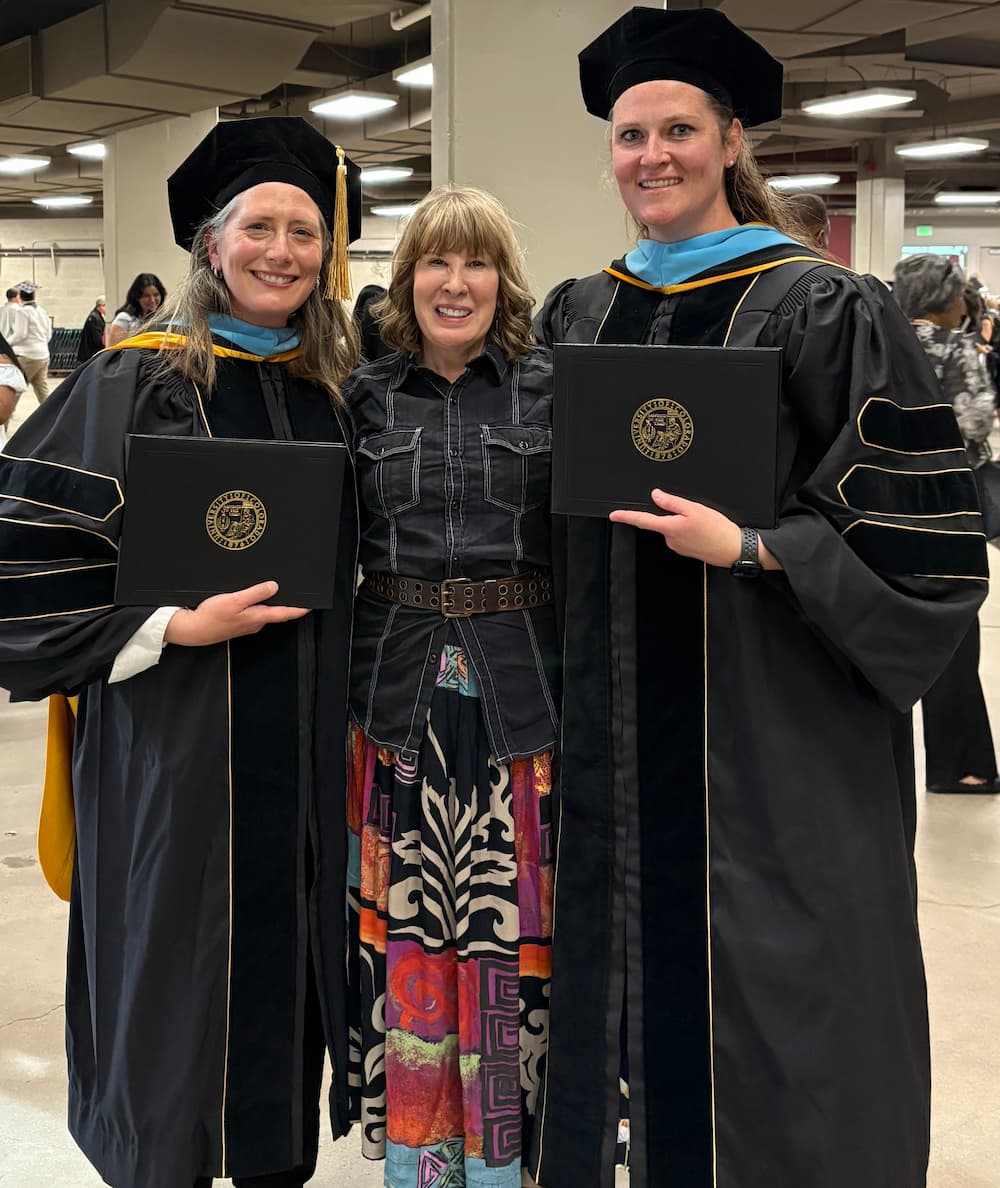
Dunlap with doctoral graduates in May 2025
Research that Continues to Shape the Field
Over more than two decades at CU Denver, Dunlap has contributed sustained scholarship on online learning, inclusive design, and learner-centered instructional practices. Her work bridges conceptual frameworks and applied practice, offering research-based guidance to educators navigating evolving learning environments.
Her ongoing research continues to examine how intentional design decisions influence belonging, engagement, and performance across diverse contexts. Through collaboration and rigorous inquiry, Dunlap’s scholarship continues to shape the future of teaching and learning.