

Coming Home: CU Denver’s W.E.B. Du Bois Gathering Closes Black History Month with Courage and Care
Julia Cummings | School of Education and Human Development Mar 9, 2026.jpg?sfvrsn=3d31a2b4_1 "UCD (196)")
The W.E.B. Du Bois event at CU Denver involved more than 90 participants and unfolded over the course of an energizing afternoon and evening on Friday, Feb. 27, 2026. It began with panel discussions followed by a formal welcome and culminated with a keynote by Brenda J. Allen, PhD, professor emerita and nationally recognized leader and author of the book Difference Matters. The atmosphere was warm and electric with anticipation. Each stage of the program built toward the next, shaping a collective arc: naming truths, exploring identity, connecting struggle to action, and ultimately calling the community to courage in truth.
Aligning Action with Values & Purpose
.jpg?sfvrsn=df32a2b4_1)
Moderator Teara Lander, PhD, and a trio of community-rooted organizers—Meera Alul, Katie Leonard, and Rokhiya Ngom—opened the event with a panel discussion about the intersection of W.E.B. Du Bois's legacy and contemporary activism in Colorado. Their message emphasized that meaningful change often begins with small personal acts that lead to larger community organizing.
Topics included:
- Art as political truth-telling by returning to cultural heritage as a source of strength and empowerment among community members.
- Organizing as a necessary part of storytelling through open discussions meant to unite communities in their shared struggles, and
- Compassion as a form of capacity-building to foster resilience.
Panelists shared their lived experiences of activism, highlighting “Art is political” utilizing Palestinian tatreez (a traditional form of ancient cross-stitch embroidery and vital aspect of Palestinian cultural identity), Mile Hay Souk mutual aid markets, and Sudanese poetry. Connecting Du Bois’ lifelong commitment to civil rights and social justice, panelists discussed advocacy victories and honest conversations that became catalysts for greater organizing efforts. The panel’s tone was direct, candid, and deeply human.
Double Consciousness, Healing & Home
.jpg?sfvrsn=b832a2b4_1)
The second panel discussion shifted inward, honoring the intellectual lineage of W.E.B. Du Bois by exploring double consciousness—the tension between self-perception and society’s imposed narratives. Moderator Faye Caronan, PhD, and panelists Edelina M. Burciaga PhD, Jarrett Hurd, MA, LPC, and Shawn Trenell O’Neal, PhD, connected Du Bois’s frameworks to contemporary experiences of Black, immigrant, and Latinx communities.
Themes included:
- The psychological burden and analytical power of double consciousness
- Identity navigation under white supremacy, nativism, and xenophobia, and
- The role of Ethnic Studies in giving students the language and tools to articulate experiences of oppression and heal through understanding.
Panelists shared examples ranging from crisis counseling in Denver to research on undocumented youth navigating hostile policy climates.
Framing the Importance of the Event
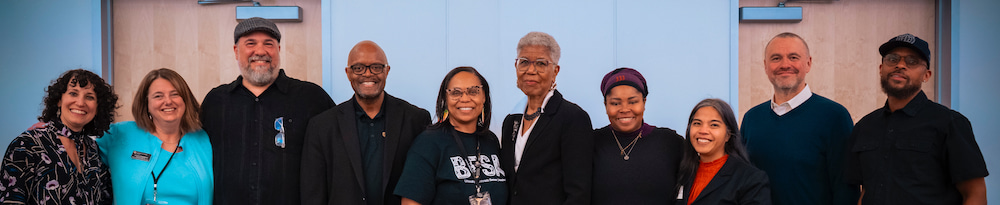
Next, the event transitioned into its formal welcome stages, grounding its meaning in institutional purpose.
Dean Marvin Lynn, PhD, and antwan jefferson, PhD, emphasized that 2026 is a year woven through with meaning: including the 100th anniversary of what began as Negro History Week and a moment when national debates about race, history, and education make gatherings like this essential rather than optional.
Chancellor Ken Christensen celebrated CU Denver’s role in championing diversity, saying: “We are committed to creating a university where every student can succeed and where every member of our community feels a sense of belonging. When we remove barriers, when we amplify diverse voices, and when we create pathways for our learners to thrive, we elevate the entire university.”
Provost Karen Marrongelle echoed the importance of celebrating diversity, reminding attendees: “We need to model for our students what it means to hold strong principles, to ask hard questions, and to interrogate the world with care and courage.”
Carlos Reali gave a warm introduction to keynote speaker Allen, his former colleague, mentor, and friend.
Keynote — Brenda J. Allen’s “Coming Home to Truth: A Du Bois Call to Courage”
.jpg?sfvrsn=1532a2b4_1)
Allen’s keynote invited the audience into a shared reckoning, rooted in Du Bois’s insistence on truth-telling as both intellectual, emotional, and moral labor. She asked participants to face Du Bois’s defining question: “How does it feel to be a problem?”
Voices filled the room: Black women in academia, immigrants, parents navigating inequitable schools, students managing stereotypes. Allen affirmed each one, articulating the paradox at the heart of double consciousness. Double consciousness is exhausting, yes; however, it also gives individuals an expanded capacity to see what others can’t see.
She extended Du Bois’s instruction into the present: “Come home to truth, and practice the courage that truth requires.”
From there, Allen introduced what she called moral steadiness: courage that is not loud but persistent, grounded, and resistant to bitterness.
Her framework for action included:
- Guarding historical integrity against erasure
- Naming race explicitly, not through euphemisms
- Transforming knowledge into power—especially in educational institutions, and
- Practicing courage without bitterness, choosing clarity over exhaustion.
When she asked, “What are you doing? What have you done? What will you do?”, audience members offered stories of advocacy, fear, resistance, and agency—from confronting injustices to reframing “aggression” as community-rooted leadership.
A Tradition Becoming a Trajectory
As commitments were spoken aloud and written onto note cards, the event revealed itself not just as a gathering but as a growing movement—one turning intention into shared responsibility. What began as panels and conversation had become a community practice: telling the truth together, holding the weight of history together, and choosing courage together.
The plan is for the W.E.B. Du Bois gathering to take place next year from Feb 26-27, 2027. The theme will be Democracy, Education, and the Global Struggle for Liberation.
The work to improve lives, Allen reminded everyone, begins now as we come home in truth together.