

The Pattern Seeker
Rashmi Gangamma has spent her career studying the forces that shape relationships, families, and communities—and helping future therapists do the same.
Julia Cummings | School of Education and Human Development Jul 29, 2026
Rashmi Gangamma, PhD, LMFT has spent her career searching for patterns—not just in relationships, but in the larger forces that shape them: family dynamics, cultural influences, community connections, and social systems. As a researcher, educator, and director of University of Colorado Denver's Couple and Family Therapy program, she is helping future therapists understand those connections while leading a recently reaccredited program into its next phase of growth and innovation.

Gangamma teaching a Couple and Family Therapy class at CU Denver.
Looking for Connections
"I've always been curious about patterns," Gangamma says. "Why people do what they do, how relationships work, and how larger systems influence individual lives." That curiosity led her from psychology to social work and family science to a research and teaching career focused on strengthening the well-being of diverse families and communities.
The thread runs through nearly everything she does.
As a researcher, Gangamma studies mental and relational health among immigrant and refugee families, exploring how social, cultural, and systemic factors influence the ways people build relationships, navigate transition, and maintain well-being. Her work centers on a simple premise: To understand people, couple and family therapists must understand the systems that shape their lives.
For Gangamma, research is an opportunity to uncover patterns that might otherwise go unnoticed. By examining relationships within the larger contexts of culture, community, and society, she seeks to better understand the forces that influence family well-being and human connection. Readers interested in exploring the breadth of her scholarship, including theory development, can view her publications and citations through her Google Scholar profile.
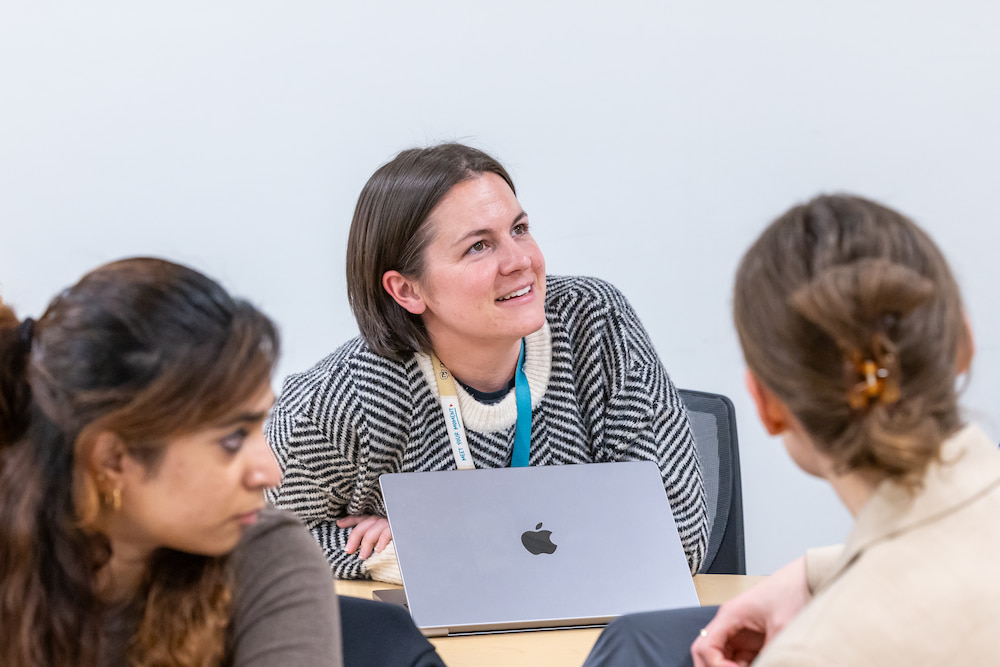

Students experiencing a Couple and Family Therapy class.
Zooming In and Out
The questions that drive her research often find their way into the classroom.
Gangamma encourages students to think beyond symptoms and diagnoses and consider the environments in which people live, work, and build relationships. Whether discussing cross-cultural experiences, family dynamics, or emerging challenges facing mental health professionals, she asks future therapists to see clients within the larger systems that shape their lives.
"The ability to zoom in and zoom out is incredibly important," Gangamma says. "You might have multiple people sitting in the room, each with their own feedback, experiences, and realities. A therapist has to understand each person's perspective while also paying attention to the relationship itself and the broader systems influencing it. You're always moving between the individual and the bigger picture."
Preparing the Next Generation
That mindset has helped Gangamma lead the Couple and Family Therapy program. Recently, the program earned reaccreditation from the Commission on Accreditation for Marriage and Family Therapy Education (COAMFTE), affirming its commitment to rigorous standards in curriculum, clinical training, assessment, and student outcomes.
Gangamma views reaccreditation as more than an administrative milestone. The reaccreditation process created an opportunity to ask many of the same questions that guide her research: What are students experiencing? What challenges are emerging in the field? How can the program continue to evolve to meet the needs of families and communities?
Those conversations led to meaningful updates, including a new clinical handbook and coursework addressing contemporary issues such as technology and artificial intelligence in therapy, gender-diverse families, and culturally responsive practice.
"When our students and alumni speak up, we listen," Gangamma says. "We want to make sure we're preparing students for the realities they'll encounter as therapists."
That commitment to listening and continuous improvement reflects a philosophy she learned from mentors throughout her own academic journey. Today, she seeks to pay that support forward by challenging students to think differently, grow as clinicians, and contribute meaningfully to their communities.
The Most Meaningful Pattern of All
Some of the most rewarding moments come after students leave campus. Graduates carry the program's mission into doctoral programs, research fellowships, clinical supervision roles, and therapy practices that serve families and communities. Their work extends the program's impact far beyond the classroom.
Looking ahead, Gangamma is energized by opportunities for new research collaborations, stronger community partnerships, and continued innovation in therapist education. The challenge and the opportunity lie in seeing how those pieces fit together.
"It's our responsibility as faculty to create an environment where learning can happen and students can get to their potential," Gangamma says. "I want to work to reduce any barriers and make sure they get all the support they need."
For a pattern seeker like Gangamma, the work has always been about creating the conditions for people to thrive in connection with others. Every couple and family therapist she helps prepare will go on to work with people navigating the human experience. Those Couple and Family Therapy program alumni, and the clients they serve, become part of something larger: a ripple effect of stronger relationships, healthier families, and more resilient communities. In many ways, that may be the most meaningful pattern of all.
Interested in becoming a couple and family therapist? View the video and learn how to apply at: education.ucdenver.edu/cft.