

Ester de Jong’s Work Shapes How Multilingual Learners Are Taught and Valued
Julie McMorris | School of Education & Human Development Apr 15, 2026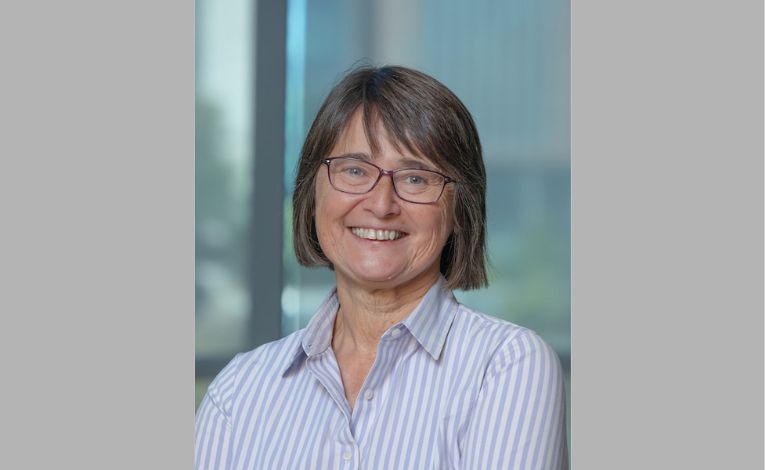
Language as Identity, Power, and Belonging
For Ester de Jong, EdD, associate dean for research and academic affairs in the School of Education & Human Development, whose research has shaped how educators across the country understand bilingual education and multilingual learners, language has never been just a tool for communication. It is a lens through which schools assign value, belonging, and opportunity. Her widely cited work in bilingual education, teacher preparation, and language policy is rooted in experiences that began long before she entered academia.
Born and raised in the Netherlands, de Jong first became acutely aware of language as a marker of identity when she left the northern part of the country to attend university in the south. “I suddenly realized that I was one of the very few people there that spoke Dutch in the way that we speak it in the north,” she said. “The reactions from people were quite mixed.” That experience sparked a deeper awareness of how language varieties are judged and how those judgments translate into social hierarchies.
Despite her reluctance to define her work by metrics alone, de Jong’s scholarly influence is unmistakable. Her curriculum vitae lists more than 140 publications, reflecting decades of collaborative, practice‑oriented research. Independent analyses underscore that reach: according to Google Scholar, her work has been cited more than 7,500 times, with several articles, such as “Preparing Mainstream Teachers for English-Language Learners: Is Being a Good Teacher Good Enough?” and “Misconceptions About Teaching English-Language Learners,” ranking among the most cited in the field. She is also included in the global Stanford–Elsevier database of the world’s most‑cited researchers, which affirms not only the volume of her scholarship but its enduring impact across disciplines. The full dataset is publicly available through Elsevier’s open repository.
Growing Up Multilingual, Seeing Inequity
Multilingualism was a given in de Jong’s upbringing. Students in the Netherlands are required to learn multiple languages, and on the surface, multilingualism is valued. But she quickly noticed important distinctions. “Dutch and English or Dutch and French were valued,” she said. “But once it became Turkish or Moroccan, we treated those languages very differently.”
Even in a multilingual society, not all languages carry the same status. Schools, she observed, often reinforce those hierarchies, shaping children’s access to opportunity in lasting ways.
Discovering Bilingual Education in the U.S.
That realization led de Jong toward bilingual education. While completing her master’s degree at Tilburg University, she interned at the Massachusetts Department of Education, where bilingual education was far more established.
“In Massachusetts, bilingual education was much more common,” she said. “I learned a lot more about what that could be for bilingual learners, and that’s kind of how I rolled into that field.”
Connecting Bilingual Education, Teacher Preparation, and Policy
Today, de Jong, as an associate dean and co-editor of the Bilingual Research Journal, is involved in work that spans bilingual education, teacher education, and language policy. “You cannot do high-quality bilingual education if you don’t have good bilingual teachers,” she said. “And we cannot do schooling for multilingual learners very well if we don’t have everybody understand what it means to work with multilingual learners.”
Because most multilingual students spend much of their day in general education classrooms, she emphasizes that all educators must be prepared to support them. In her work, she emphasizes that working with multilingual learners is not just good teaching. It requires specialized knowledge, skills, and understanding of what it means to learn in and through languages other than the majority language of school.
How Policy Decisions Shape Classroom Practice
Policy plays a critical role in shaping what happens in schools. State policies may encourage or restrict bilingual programs. Districts decide which models to implement. Teachers make daily choices about language use, materials, and participation.
“Those are policy decisions, even though they happen at the classroom level,” de Jong said. When policies align, they can strengthen practice. When they do not, they often constrain what educators are able to do for multilingual learners. Especially in today’s educational climate, attention to teacher agency and professionalism is extremely important.
Rethinking Equity Beyond Access
Equity and access have been central themes in de Jong’s scholarship, though her thinking has evolved over time. Early in her career, equity meant ensuring access to bilingual programs and giving equal status to languages within those programs.
“Over time, I’ve come to realize how complicated equity is,” she said. “A program is just a program. What really matters is access to quality schooling and access to opportunities to learn.”
She now emphasizes moving beyond surface-level solutions to examine the systems that shape schooling more broadly.
Transforming Systems, Not Just Practices
“If we really want to do right by multilingual students, we need to start transforming the system,” de Jong said. That work requires challenging long-standing assumptions, including the dominance of English-only, monolingual norms in U.S. education.
Equity, she added, cannot be reduced to language alone. Culture, identity, and students’ lived experiences matter. “We can’t have equity if students don’t feel that they belong.” Belonging, she argues, is foundational to meaningful learning.
Research Meant to Reach the Classroom
De Jong measures success by whether her research reaches educators and shapes practice.
“I’ve always tried to make my writing accessible,” she said. “If I only write for my peers in academia, that’s interesting and important, but it doesn’t always or necessarily change practice. Both are needed.”
Teachers frequently contact her to share how they have used her work in professional development or classrooms. “To me, that’s the biggest compliment,” she said.
Scholarship That Met the Moment
Several of de Jong’s publications resonated widely because they addressed pressing issues at critical moments. Collaborative work challenged the assumption that teaching multilingual learners is simply an extension of good teaching, helping articulate the specialized knowledge educators need.
Her 2011 book further bridged research and practice by outlining guiding principles rather than prescribing rigid solutions. “These are nonnegotiables if you want to do right by multilingual learners,” she said, “but we cannot prescribe what the best approach is in a particular context.”
More recently, her research has examined dual language programs that integrate fluent English and Spanish speakers, highlighting both their promise and the need to attend carefully to emerging inequities.
Leadership Through a Research Lens
Leadership roles have also shaped de Jong’s perspective. Serving as president of TESOL International Association broadened her understanding of the global diversity of English language teaching contexts. Administrative roles in higher education have pushed her to think about how institutions support research and communicate its value beyond the academy.
“You learn to see things from many different perspectives,” she said. That perspective now informs her work supporting faculty research across the School of Education & Human Development.
Mentoring the Next Generation
Mentorship is a defining element of de Jong’s career. She is deeply invested in supporting doctoral students and early career scholars through different venues. Asked what advice she would give to scholars who hope their work will be widely cited, she is direct. “I wouldn’t focus on getting cited,” she said. “Think about the impact you want to make.”
Looking back, she credits the mentors and collaborators who supported her along the way. “We don’t get to these places by ourselves,” she said.
Redefining What Influence Looks Like
For de Jong, influence is not about visibility alone. It is about shifting how educators understand multilingual learners and creating school systems that recognize linguistic and cultural diversity as a strength rather than a challenge.
Through her scholarship, leadership, and mentorship, she continues to shape how multilingualism is taught, valued, and sustained in schools across the country.